Dimensionality Reduction
What is Dimensionality Reduction
Dimensionality reduction reduces the number of input features while preserving as much meaningful information as possible.
There are two main approaches:
- Feature Selection: keep some original features
- Feature Extraction: create new lower-dimensional features
Feature Selection
= selects a subset of the original features based on their importance, relevance, or redundancy
See Feature selection for detailed methods.
Main types:
- Filter methods: use statistical scores before modeling
- Wrapper methods: search feature subsets using model performance
- Embedded / Intrinsic methods: feature selection happens during model training
Feature Extraction
= transforms original features into a lower-dimensional space using mathematical techniques
Linear / Matrix-based Methods
Principal Component Analysis (PCA)
linear technique that finds orthogonal components maximizing variance in the data
Component Selection Criteria
= decides how many principal components to keep
- Scree plot: plot eigenvalues / explained variance and keep components before the curve becomes flat (the "elbow")
- Kaiser rule: keep any component with eigenvalue above 1, usually when features are standardized
- Cumulative variance threshold: keep the smallest number of components that explain enough total variance, e.g. 80-95%
Singular Value Decomposition (SVD) / Truncated SVD
matrix factorization method that finds lower-rank structure in data
- often used for sparse data, text data, and recommender systems
- similar goal to PCA, but Truncated SVD can work without centering sparse matrices
Independent Component Analysis (ICA)
finds components that are statistically independent, not just uncorrelated
- useful when signals are mixed together, e.g. separating audio / brain signals
Non-negative Matrix Factorization (NMF)
factorizes data into non-negative parts-based components
- useful for topic modeling, images, and count-like data
Random Projection
projects data into a lower-dimensional space using a random matrix
- fast approximation, useful when the original data is very high-dimensional
Supervised Projection
Linear Discriminant Analysis (LDA)
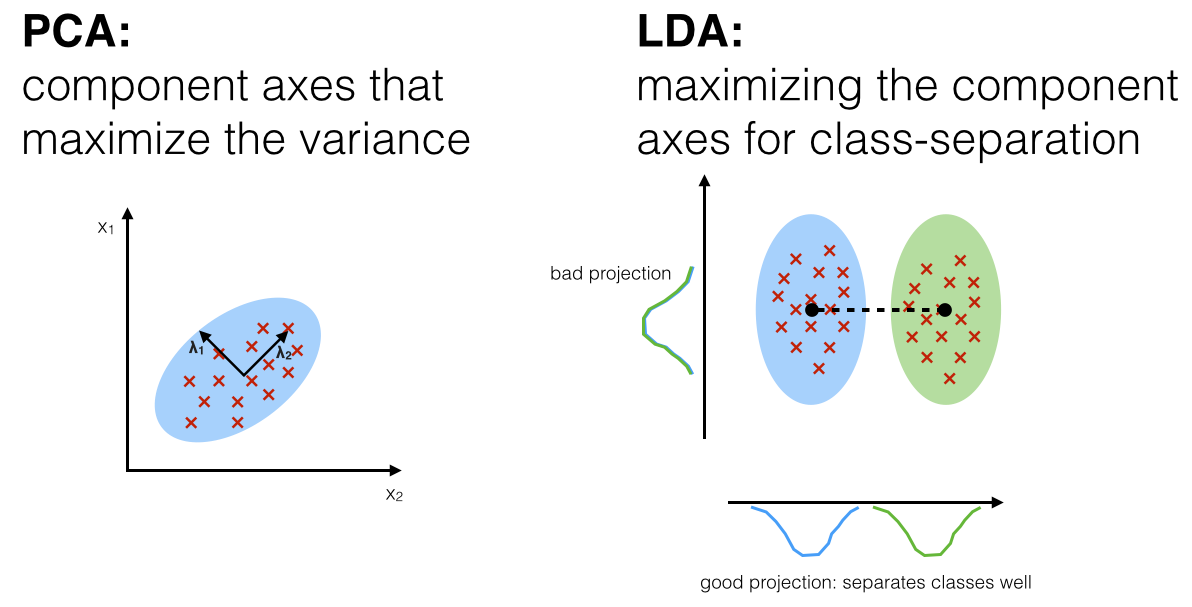
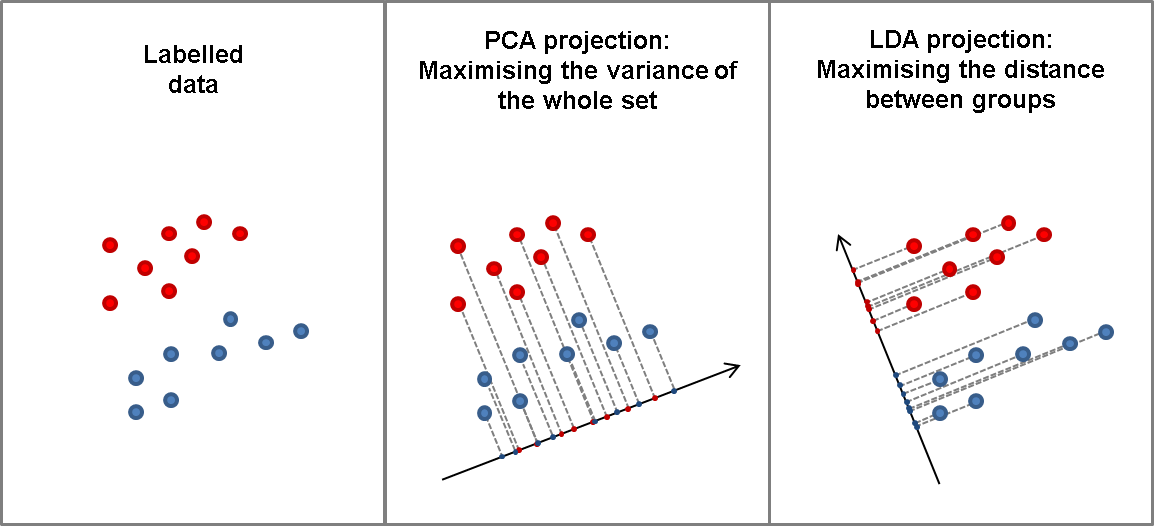
supervised method that projects data to maximize class separability
- max number of components = number of classes - 1
- it creates new axes to maximize the class-separation, step by step (2-class example):
- maximize the distance between class means
and - minimize the variation (which LDA calls "scatter") within each class
and - compute
(= ) and LDA should maximize it - if more than 2 classes, e.g. there are 3 classes, the value to be maximized will be
- maximize the distance between class means
- PCA captures the variability; LDA class separation
- PCA is unsupervised; LDA is supervised (because of the relation to the dependent variable)
Non-linear / Manifold Learning
Kernel PCA
extends PCA using kernel methods to capture non-linear patterns
t-Distributed Stochastic Neighbor Embedding (t-SNE)
non-linear dimensionality reduction method mainly used for visualization in 2D/3D, optimized for preserving local structure
- t-SNE takes high-dimensional data and reduces it to low-dimensional coordinates (2-D typically)
- it calculates a similarity measure based on the distance between points instead of trying to maximize variance.
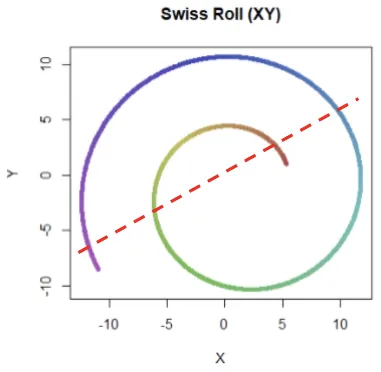
- Unlike PCA (which is linear), t-SNE can reduce dimensions with non-linear relationships (such as “Swiss Roll” non-linear distribution)
- mainly for visualization, not usually for creating features for a predictive model
Uniform Manifold Approximation and Projection (UMAP)
- fast and scalable non-linear dimensionality reduction method, preserves both global and local structure
- similar to t-SNE but faster and often better at retaining overall shape
Isomap
non-linear manifold learning method that preserves geodesic distances on a manifold
Locally Linear Embedding (LLE)
non-linear manifold learning method that preserves local neighborhood relationships
Multidimensional Scaling (MDS)
places points in lower dimensions while preserving pairwise distances as much as possible
Neural Network-based
Autoencoders: see Autoencoders
neural network-based models that learn a compressed latent representation through reconstruction
Related but not really dimensionality reduction
Quadratic Discriminant Analysis (QDA)
similar to LDA but assumes each class has its own covariance matrix, allowing quadratic decision boundaries
- not really a dimensionality reduction method; more commonly used as a classifier