Regularization
Regularization
What is regularization
- Regularization = the process of adding information in order to solve an ill-posed problem or to prevent overfitting.
- Intuition:
Increasing the regularization parameter( >0) reduces overfitting by reducing the size of the parameters. For some parameters that are near zero, this reduces the effect of the associated features.
Alternative intuition for deep neural networks:
Regularization reduces overfitting by letting the weight of units decay and get closer to 0 (given thatare usually large). If the weights almost zero, than the networks becomes almost linear and will avoid overfitting.
Cost function with regularization
When you choose regularization, a regularization term will be added to the cost function.
See Cost Functions#Cost function with regularization.
Types of Techniques
shrinking (= add penalty/reduce weight/weight decay)
-
L1 regularization (lasso): Cost Functions#^19a2bf
-
L2 regularization (ridge, "weight decay"): Cost Functions#^b2a01f
-
elastic net regularization: = L1 + L2 regularization
, where
dropout regularization
- randomly knocking out units in neural network
- used only during training
- mostly used in computer vision (e.g. Pattern Recognition)
batch-normalization
- applies normalization on the inputs of hidden layers
- weakens the coupling between what the early layers parameters have to do and what the later layers parameters have to do. So it allows each layer of the network to learn by itself, a little bit more independently of other layers, and this has the effect of speeding up of learning in the whole network.
- can add a slight regularization effect because of adding noise to hidden layers
data augmentation
- usually in computer vision
- = generate more labeled images by taking labeled images and
- flip them left/right
- shift them up/down/right/left by a couple pixels
- add small noise, etc...
- but if the validation set doesn't have the same randomness, then the accuracy fluctuates crazily.
early stopping
- Initialize with small weights -> these get bigger as you do gradient descent- > stop when they are the ‘optimal’ size
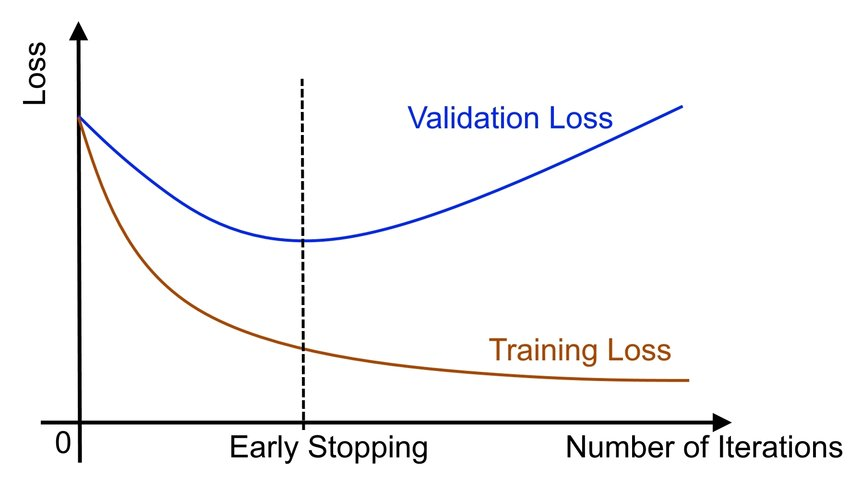
Interesting
But long-term training may lead to flip in large models, see here
Regularization in Bayesian framework
- A regularizing prior is a "skeptical" prior, which means it slows down the rate of the model in learning from the data.
- Multilevel models can be regarded as adaptive regularization, where the model itself tries to learn how skeptical it should be.
- It is a Bayesian method. It is the same device that non-Bayesian methods refer to as “penalized likelihood.”